Coming Home to Your Body
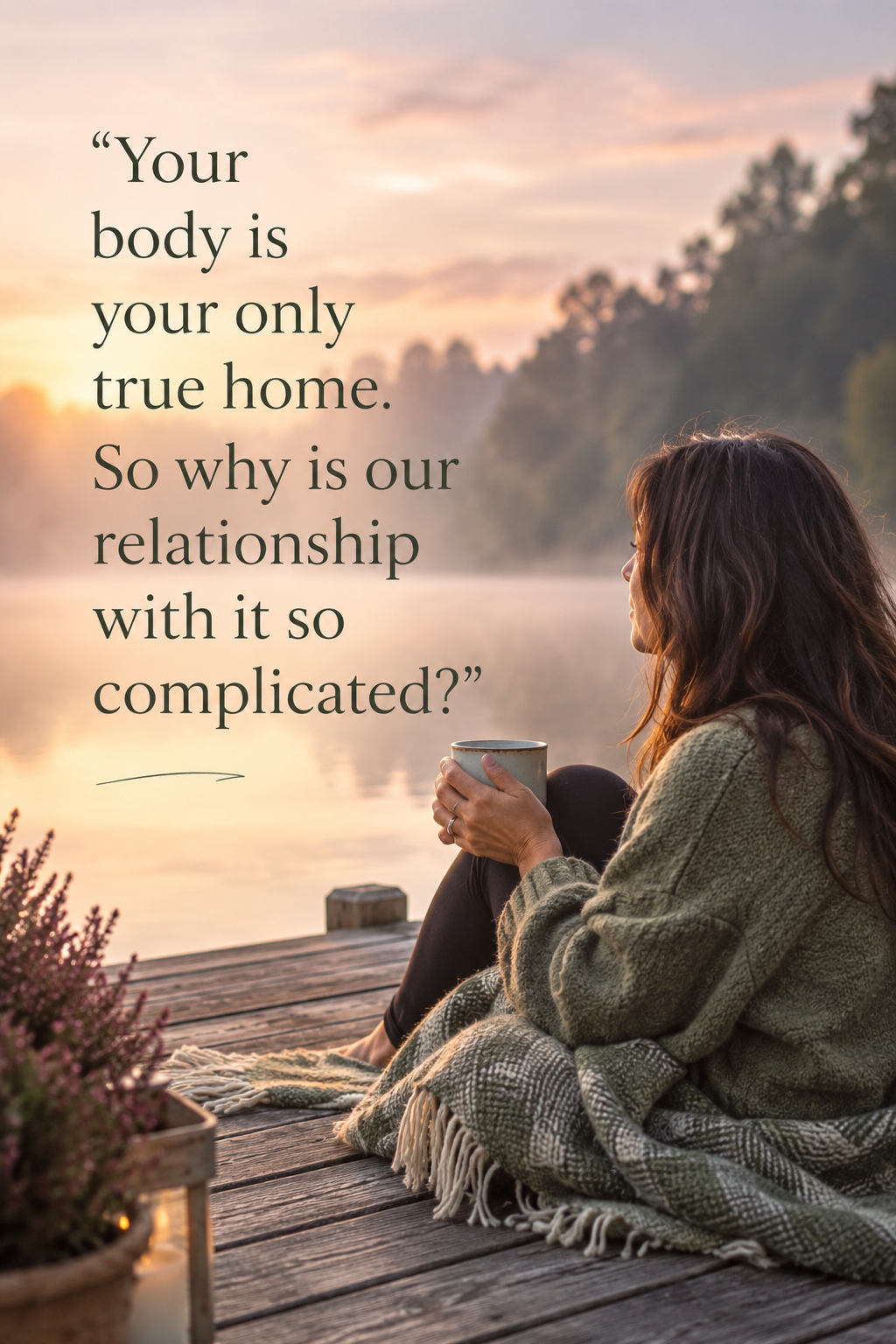
Your body is the only home you will ever truly live in. So why is our relationship with it so complicated?
After 54 years of living and fighting with my body, I have observed myself and those around me, in my western culture, having very negative relationships with our bodies. Our shell. Our first and only real home. There is something slightly contradictory about the relationship many of us have with our bodies. It is the only body I will ever have; it has carried me through every single day of my life. and for me personally, I have been blessed in that my body has grown babies, birthed them, healed, adapted, survived illness and surgery, carried me through long shifts, run miles, hugged people I love, danced, rested, laughed until it hurt and occasionally kept going when I probably should have stopped. It is, quite literally, my home. And yet I can still stand in front of a mirror, be completely in love with the scars, the reconstruction, the stretch marks that show where my babies grew… but also focus entirely on the menopause weight around my middle that I desperately want to shift but doesn’t budge!
How can both of those things be true? Actually, quite easily, because none of us develops our relationship with our body in isolation. From childhood onwards, we absorb messages about what bodies are supposed to look like, what they should weigh, what we're supposed to eat, how much we should exercise and which parts of ourselves apparently need improving. Family, friends, magazines, television, advertising and now social media all contribute to the picture we build of what an “acceptable body” looks like. It has become the norm to want to tweak, change, shrink or morph bits and bobs. It’s almost “weird” to be completely happy and comfortable in your body.
So how do we, as individuals, get here? Well, simply it is learned behaviour. For me personally, I can trace some of my own relationship with my body right back to being fifteen. My mum told me I had a big bum and put me on the Hip and Thigh Diet. I was probably a size 8. I remember the day vividly; it was the same day she told my sister she was too skinny and put her on a meal supplement. It was the start of a lifetime of body image issues for both of us. Don’t get me wrong, I don't tell that story to criticise my mum. This was the mid 1980’s, she was living in exactly the same culture I was growing up in, women were constantly being told that smaller was better, certain foods were “naughty”, treats were cheats, cellulite was something to wage war against and apparently an entire diet could be designed specifically to eradicate your thighs. But somewhere in my fifteen-year-old brain, a message landed: there is something about your body that is wrong, and it needs changing.
Once that thought embeds in the sub-conscious mind, we become very good at finding new things to apply it to. Too big here, too soft there, not toned enough, too wrinkled, too hairy, too flat, too curvy, too old. We can take this extraordinary organism that is keeping us alive and reduce its entire worth to a small area of flesh we don't particularly like, and “needs to go”. The media has become extremely good at helping us do it and we're constantly being sold solutions to “problems” we're led to believe we have: lose weight, tone up, reverse ageing, flatten your stomach, fix your skin, transform yourself. Social media has added another layer because we now have unprecedented access to other people's bodies, and AI versions of what is deemed as right. However, we're often comparing our ordinary Tuesday-afternoon body with somebody else's best photograph, best lighting, best angle, filter, edit or carefully curated version of reality.
Children are watching this too. They hear adults criticise their own bodies. They hear us say we're “being good” because we ordered the salad or “being naughty” because we ate cake. They notice which bodies receive compliments and which become the subject of criticism. Without realising, we are blindly teaching children how to judge their bodies long before they're old enough to understand who created the rules in the first place.
And then your body changes anyway!
Pregnancy completely changed my relationship with mine. I loved my pregnant body. For perhaps the first time, I wasn't primarily looking at it in terms of appearance; I was fascinated by what it was doing. It felt powerful, capable and extraordinary. I carried my babies loud and proud! my bumps were huge and I loved it …. baby No.1 brought poly-hydramnios with her (excess amniotic fluid) which stretched me even further and brought what can only be described as a road map of Great Britain across my stomach. These stretch marks were my Tiger Stripes, and I earned them by becoming a mama, I still love the silvery lines they left behind 32 years later. Three babies later, things had most definitely not “bounce back”. And that re-triggered the “need to be smaller” factor!
Now, as a midwife, I'm also acutely aware of the privilege contained within that story. I had relatively straightforward pregnancies and births, and not everybody gets to experience pregnancy or birth as empowering. Bodies don't always behave according to the plan we've been sold, and pregnancy, birth, illness, injury or trauma can profoundly change the relationship somebody has with theirs.
That's one reason I'm wary of casually telling people to “trust your body”. Sometimes that trust has been damaged. Sometimes your body has frightened you. Sometimes it hurts. Sometimes it has changed beyond recognition. Sometimes it doesn't reflect who you know yourself to be. And sometimes you can simply feel frustrated with it. “Just love your body” isn't the answer, our relationships with our bodies can be far more psychologically complex than that.
For somebody experiencing body dysmorphia, for example, distress and preoccupation around perceived flaws can significantly affect everyday life. For some trans and gender-diverse people, the relationship between the body, identity and how other people perceive them can involve gender dysphoria and considerable distress. Then there are scars, disability, chronic illness, ageing, fertility difficulties, pregnancy loss, cancer treatment, weight changes, menopause, medication and surgery. There are countless reasons why somebody's relationship with their body might be difficult. That's why I don't think simply telling everybody to “love your body” is particularly helpful. It can become yet another expectation we're supposed to achieve. Perhaps a more realistic place to begin is asking: Can I stop treating my body like the enemy?
Another era that rocked my relationship with my body, was the breast cancer era. I had chemical and then surgical Menopause at age 44, and no HRT to help, it was brutal! And a mastectomy and reconstruction and now have one natural breast and one reconstructed with an implant, with an obvious significant difference in size and shape between the two. Surprisingly, this does not bother me in the slightest, apart from bra shopping which is an emotional challenge, but the scars and asymmetry themselves are simply part of me, and I am happy with that. Interestingly though, the spare tyre around my middle following menopause is the focus of my bother!! It is the first thing I look at when I see a reflection, a photograph, it bothers me far more than I would like it to. It bothers me that I am bothered!!
I find that fascinating and frustrating. How can I look at scars from major surgery and think, they're part of my story, yet catch sight of a perfectly ordinary area of flesh around my middle and decide that is somehow less acceptable? My body has survived cancer and undergone major surgery, and I have somehow found it easier to make peace with those changes than with my abdomen. That isn't simply about biology. There is a lifetime of conditioning embedded into my subconscious mind in that reaction.
Conversations about health and lifestyle can also become far too simplistic. Most of us know the theory: eat nutritious food, move our bodies, sleep properly, manage stress, don't smoke and limit alcohol. None of that information is particularly revolutionary. But knowing what supports our health and being able to build those behaviours into our actual lives are two very different things. In the UK, we live in a culture where UPF’s ( ultra-processed foods) can be cheap, accessible and time-saving when somebody is exhausted, working long hours, short on money or trying to feed a family. Exercise can cost money. Gym culture can feel intimidating, particularly if you already feel self-conscious about your body. Time is a genuine barrier, as are pain, disability, fatigue, childcare, shift work, confidence and simply not knowing where to start. Then there are the psychological elements: habits, stress, comfort eating, motivation, self-belief, previous experiences with dieting and exercise, and the stories we've accumulated about what we're capable of.
“Just make healthier choices” isn't a behaviour-change strategy.
This statement ignores a large part of what makes human behaviour complicated in the first place. Perhaps this is where we've got something fundamentally backwards. What would happen if the goal wasn't primarily to change what our bodies looked like, but to change how we felt living in them?
Maybe I want to be strong enough to carry the shopping without struggling. Fit enough to play with my grandchildren, have more stamina, rest better and be more mobile. Maybe nutrition should be more about being well nourished. Maybe having a healthy lifestyle can help us become calmer, more connected to ourselves, confident enough to walk into a yoga class without spending the first ten minutes wondering whether everybody is looking at my shape or ability.
Healthy behaviours can matter enormously without weight or appearance being either the punishment or the prize attached to them:
“I hate my shape, therefore I need to exercise” creates a very different relationship with movement from “I care about myself, therefore I want to feel stronger.”
This is where changing the mind matters
We can't undo decades of messaging with one affirmation in the mirror. Our beliefs about ourselves are built through repetition, experiences, family, culture and emotion, and some become so familiar that we stop recognising them as beliefs at all, eventually those thoughts stop sounding like opinions and start sounding like facts.
I've always hated my legs. I'm useless at sticking to anything. I have no willpower. I can't wear that. People will look at me.
Changing that relationship can mean learning to notice a thought without automatically believing it. It might mean changing habits or challenging the story underneath them. For some people it may involve psychological therapy or specialist support. For others, approaches such as hypnotherapy, mindfulness or other wellbeing practices can form part of learning to respond differently to old patterns. Sometimes it's learning to rest without feeling guilty or beginning to treat yourself with the same kindness you would automatically offer somebody else.
And perhaps some days self-kindness isn't standing naked in front of the mirror and declaring that you love every inch of yourself. Maybe it's simply choosing not to criticise the person looking back at you.
Coming home
I'm nearly 55 – I have lived for over half a century in the home that I was born in … my body! I have stretch marks, scars, an implant, wrinkles, bits that ache, bits that wobble and a menopause midriff with which I'm apparently still negotiating a peace treaty. My body isn't the body I had at 15, 21, or even 35, and I'm very glad it isn't. That 15 year old girl had barely started living in it and now this body has grown and birthed three babies. It has worked thousands of hours. It has exercised, rested, gained weight, lost weight and experienced enormous hormonal changes. It has had parts removed and parts reconstructed. It has been frightened, hurt, healed and adapted. And ten years after a cancer diagnosis, I'm still standing strong in it.
So perhaps coming home to your body isn't about finally achieving the version of yourself you've spent years trying to create. Perhaps it's about recognising that you were already living there. Looking after your body doesn't have to mean endlessly trying to make it smaller, younger, smoother or more acceptable. It can mean feeding it well because you want energy, moving it because you want strength, resting because you're tired, seeking help when something doesn't feel right, changing behaviours that aren't serving you and being curious about what your body is telling you instead of immediately trying to silence it.
There will still be days when you catch sight of the part of yourself you've never quite made peace with and wish it looked different. Self-kindness doesn't require perfection either.
My tiger stripes and scars tell my story. The rest of me is still changing because I'm still living.
My body is a work of ever-evolving art.
And perhaps my job isn't to keep correcting the artwork, Perhaps it's to take care of the only place I will ever truly call home.